



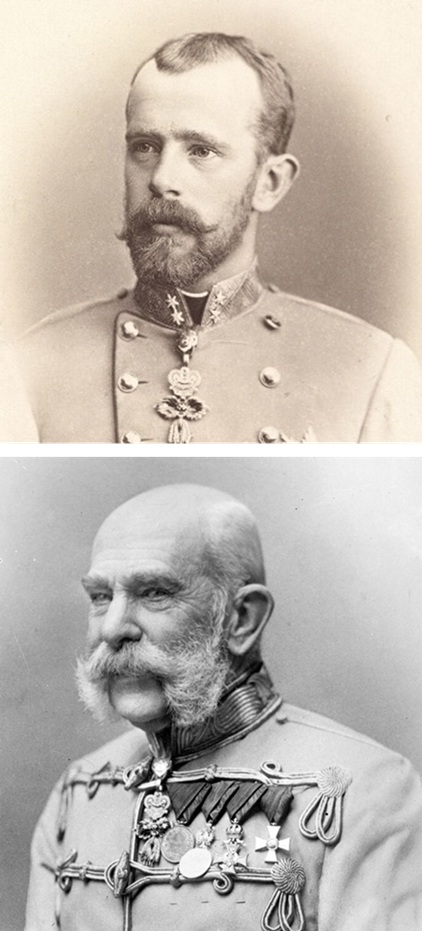
Top: Crown Prince Rudolf, about 1887 (detail). Photo credit: Fritz Lockhart.
Source: Osterreichische Nationalbibliothek (Austrian National Library)
Source: Wikimedia Commons
Bottom: Emperor Franz Josef of Austria, in uniform, circa 1892, published 1903 (detail). Credit: Library of Congress of the USA.

2. Rudolf and Politics
At the time he met Josef Rudolf's life was starting to spin out of control. One serious problem was his deep political differences with his father, Emperor Franz Josef, which brought them almost to the point of estrangement.
The conflict with his father arose from Rudolf's sympathy with the desire of Hungarian and other national groups for more independence within the empire, and his advocacy of liberal and democratic causes.
Franz Josef saw Rudolf's political stance as extremely dangerous. He feared that radical elements could dupe Rudolf into actions that would cause embarrassment to the government, or even result in acts of rebellion.
In the 1880s Austria-Hungary was a multinational and multicultural empire whose territory comprised modern Austria and Hungary plus parts of several other present-day countries: Bosnia and Herzegovina, Croatia, the Czech Republic, Italy, Montenegro, Poland, Romania, Serbia, Slovakia, Slovenia and Ukraine.
The empire was a mosaic of ethnic populations large and small, each of them possessing its own culture, traditions and language (fourteen languages were officially recognized), many of them harbouring ambitions for political independence, and all of them boasting long histories that frequently involved conflict with neighbours, ancient grudges and competing territorial claims.
In short the empire was a powder keg and Emperor Franz Josef was determined to stamp out any spark that might set off an explosion.
Franz Josef was an autocrat who had been brought up to believe in the divine right of kings to rule without interference, though he accepted the need to share power, to some extent, with an elected parliament. His chief advisors and ministers were all elected parliamentarians, but they of course shared Franz Josef's outlook and concerns.
Franz Josef's hostility toward liberal tendencies of any kind was deeply ingrained. It was exacerbated by events that he had witnessed first-hand.
In 1848 and 1849 Europe was swept by a wave of rebellions against the repressive regimes that had taken power after the defeat of Napoleon in 1815. Crop failures and economic depressions created hardship and unrest among the poorest classes, but people at other levels of society had their own, somewhat more philosophical grievances.
In Austria as elsewhere, many citizens were fed up with autocratic rule, press censorship, restrictions on individual liberties and political rights, resistance to democratic reforms and, among the empire's disparate national groups, suppression of independence movements.
The rebellions took the form of mass public protests which degenerated into riots and street fighting. In one incident Austrian troops fired into a crowd of protesters, killing five people. Vienna was briefly captured by radical insurgents and Emperor Ferdinand II (Franz Josef's uncle) fled the city.
The insurgents were soon expelled and Emperor Ferdinand, deemed incapable of dealing with the crisis, was persuaded to abdicate in favour of his nephew. Franz Josef was only 18 years old when he succeeded to the imperial throne.