




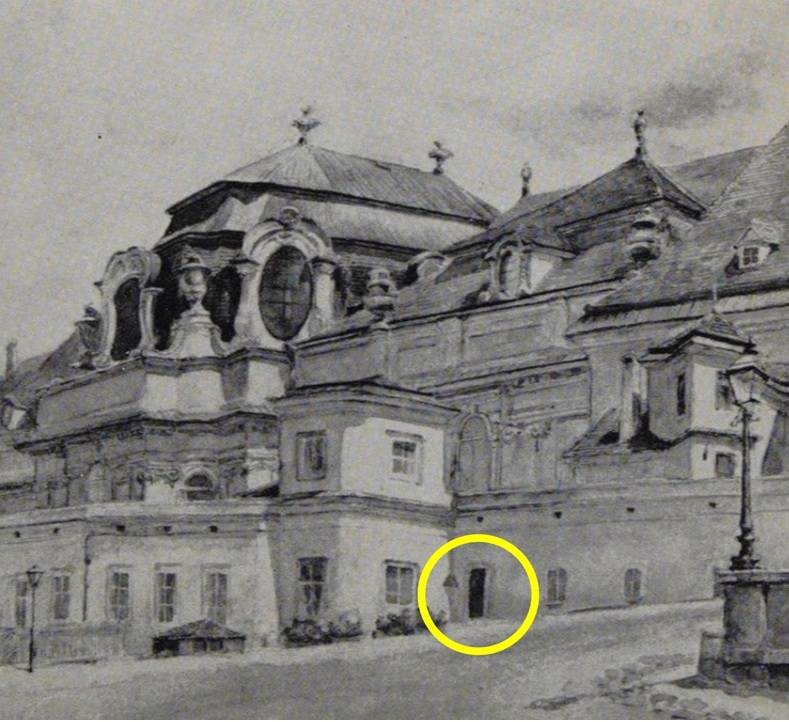
Above: The black iron door (circled) at the top of the ramp leading to the Augustinian Bastion, 1960s? (detail).
Source: Judtmann after p. 96.
8. The Black Iron Door
Josef later told Baron von Krauss that he took Mary to the Hofburg about twenty times, though he could not remember specific dates. Sometimes he picked Mary and the Countess up from the Grand Hotel, where the Countess stayed on her visits to Vienna. At other times, usually at night, he took Mary to the Hofburg unaccompanied, parking on a side street near the Vetsera town house where Mary would meet him after slipping away unnoticed.
The Hofburg is a rambling complex of buildings that have been constructed over centuries. Josef would drive Mary and the Countess, or Mary alone, to a remote wing of the palace called the Augustinian Bastion. At the top of a ramp leading to the bastion was a black iron door that was locked but never guarded. Rudolf's trusted valet, Johann Loschek, waited at the door to let the women in.
Josef would have been well aware of the dangerous, self-destructive game that Mary was playing, and he could not have helped but think of his own 17-year-old stepdaughter Antonia. But he was not the first or last cab driver to witness a life spiraling downward and being helpless to do anything about it.
The fares for Josef's trips to the Hofburg were seemingly charged to Rudolf's account at the Wollner cab firm. The charge for Mary's final, fatal journey to Mayerling was reportedly entered in the Wollner ledger as "Bratfisch drives to Mayerling, 30 florins" (Judtmann, 89).
The ledger itself was destroyed in a bombing raid during World War II but one of Fritz Judtmann's informants was Leopold Wollner's son Egon who would have known about the entry. It was likely the most significant entry in the ledger, a genuine artifact of the Mayerling tragedy, familiar to Wollner family members and perhaps shown to curious visitors.