




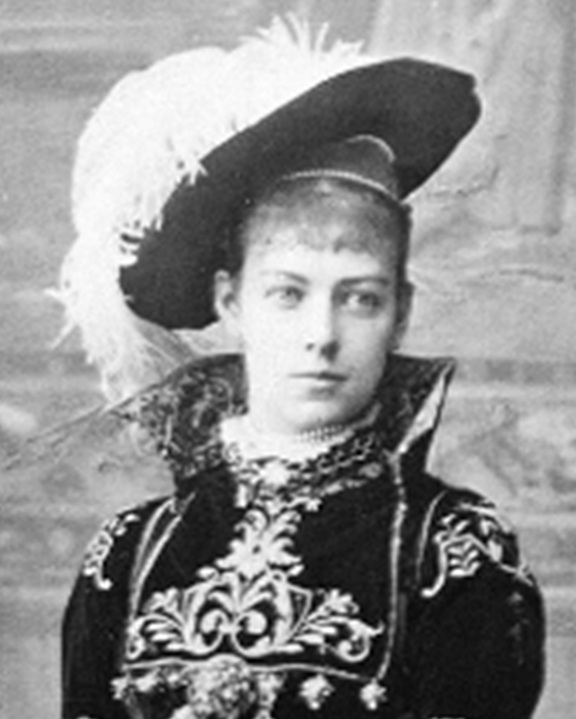
Above: Countess Marie Larisch-Wallersee (1858-1940) (Detail)
Source: Osterreichische Nationalbibliothek (Austrian National Library)
11. The Flight to Mayerling (continued)
According to the Countess's not entirely reliable story of their arrival at the Hofburg, Rudolf first asked to speak to Mary alone and then returned a few minutes later to announce that she had left for Mayerling. He told the Countess that he wanted to keep Mary for a few days to "wear down" Helene's opposition to their affair.
Then Rudolf handed the Countess an alarming note from Mary in which she wrote "I cannot go on living. Today I have gained a lead on you; by the time you catch up with me I shall be beyond rescue, in the Danube". He suggested that the Countess tell Helene that Mary claimed to be too unwell to go into the jewellery store and when the Countess returned to her cab Mary was gone, leaving the note behind. Rudolf gave the Countess 500 florins to buy the cooperation of her cab driver.
The Countess claimed that when she balked at the idea Rudolf threatened her with a revolver. It can be safely assumed that this was a melodramatic invention of the Countess's. Rudolf knew that the threat of having her role as gobetween exposed was sufficient to extort her participation.
Author Fritz Judtmann thought Rudolph must have told the Countess about the suicide pact "with the same reckless frankness" with which he had told Mizzi Caspar (Judtmann 68). But was the Countess really as close a confidant as Mizzi? Or was she simply a convenient tool who Rudolf paid to facilitate his plans?
The Countess's subsequent clumsy efforts to cover her tracks showed how easily she could succumb to panic, and Rudolf had known her long enough and well enough to assess her character. If he told her about the suicide plan he could not be sure that she would not immediately report it to Empress Elisabeth, who in turn might act quickly enough to forestall the flight to Mayerling.
The Countess was certainly cold-blooded enough to connive in the ruin of a young woman's future, but would she let Mary go to her death without trying to intervene?