




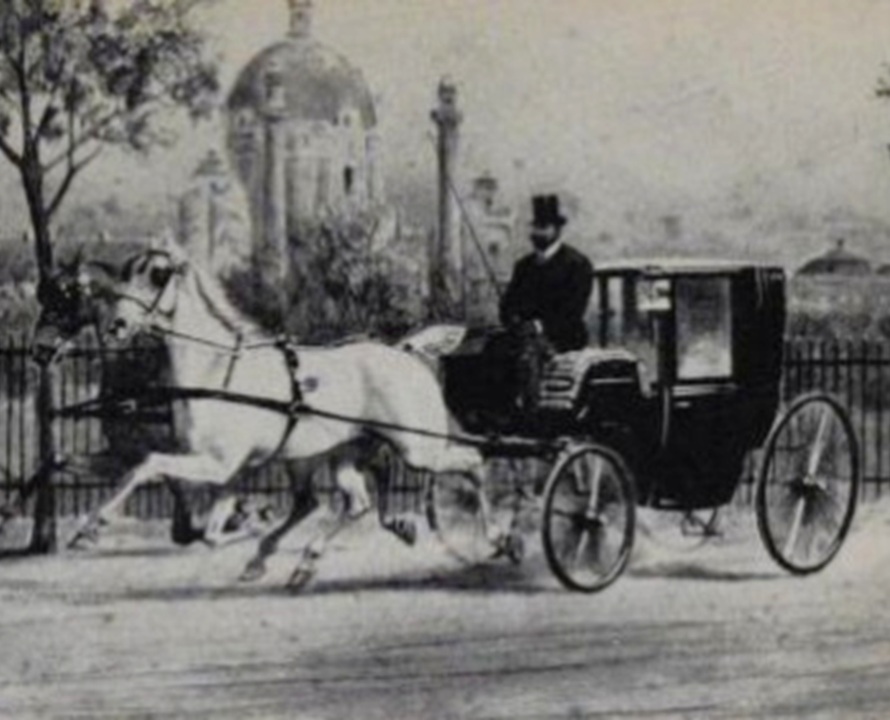
Above: "Bratfisch with his cab, 1889" (detail). "It was in one of these 'unnumbered' cabs that Mary Vetsera drove from the Hofburg to the Roter Stadel."
Source: Judtmann following page 192. Judtmann does not provide a source for this illustration or painting. The artist's initials in the lower right corner of the original appear to be "H.G.W." but the W (if that's what it is) is slightly cropped.
12. The Pursuit (continued)
The Countess, of course, was more concerned about her own reputation than she was about Helene or Mary. She therefore gave Krauss only as much information as she felt safe in divulging.
She told him the story of Mary's disappearance outside the jewelry store but concealed her own knowledge of Rudolf's and Mary's affair. She simply remarked that Mary's family suspected Rudolf's involvement.
Her cab driver, Franz Weber, claimed to have gotten off his cab to window shop and while his back was turned Mary got out of his cab and entered another one. He caught a glimpse of her driving off, but could not give a description of the driver or horses.
Krauss quickly deduced that both of them were hiding something. In his notes on their meeting he wrote: "She came to me not to make a statement but to exculpate herself." (Judtmann 100).
Krauss was especially suspicious of Weber's testimony. For safety reasons cab drivers were required to stay with their cabs and keep control of their horses. It seemed strange to Krauss that Weber would confess to a serious lapse that would expose him to a heavy penalty, not to mention the risk to his cab and its passenger if the horses ran away.
Krauss told the Countess that he did not have enough information to initiate a search for Mary and she returned to the Grand Hotel to plan her next step. Her mission had been a failure. Not only did Krauss refuse to act but she had managed to raise his suspicions.