




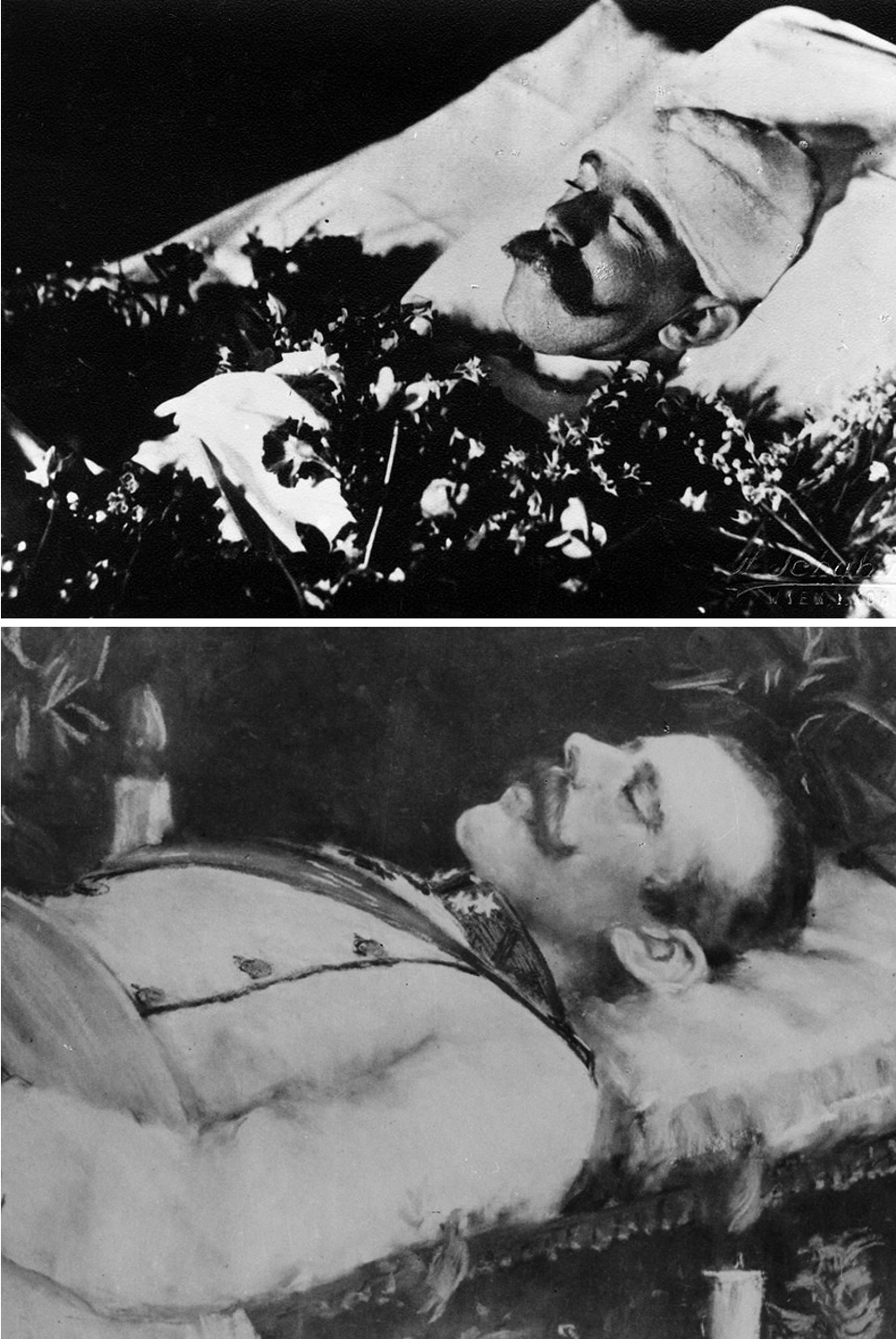
Top: Rudolf at the private lying-in-state with his head wrapped in bandages.
Source: Wikimedia Commons.
Source: Osterreichische Nationalbibliothek (Austrian National Library)
Bottom: Painting of Rudolf as he appeared at the public lying-in-state (detail).

15. Rudolf's Burial
Rudolf's body had already been transported to Vienna and Dr. Widerhoffer, with the assistance of two other doctors, conducted a formal autopsy that night. The body was then moved to Rudolf's bedroom for a private lying-in-state, the damage to his head still concealed under the bandages that Dr. Widerhofer had applied at Mayerling.
By the time of Rudolf's public lying in state, on February 3 in the Hofburg chapel, the head wound was carefully camouglaged with wax and paint.
Among the hundreds of floral tributes that arrived during the lying in state was a wreath carved out of marble and another made of gold. Another wreath, ten feet in diameter, was sent by a group of French journalists. Rudolf had always made good copy.
Had Rudolf been a lesser mortal the fact that he was a suicide might have been grounds for denying him a church burial. However, according to canon law someone who suffered from a mental illness could not be blamed for committing suicide and was therefore eligible to be buried in consecrated ground. Dr. Widehofer and his colleagues duly reported that Rudolf's autopsy revealed evidence of "momentary insanity."
Outside the Hofburg the decision to grant or deny a church burial would have been made by the Archbishop of Vienna, Cölestin Josef Ganglbauer (who was also a cardinal), but within the Hofburg this decision was in the hands of the Court and Palace Chaplain, Laurenz Mayer, who reported directly to the Vatican.
Mayer quickly accepted the verdict of insanity and authorized a church burial with full ecclesiastical honours. Mayer's decision may have been helped by his steadfast conviction that Rudolf had been murdered.