



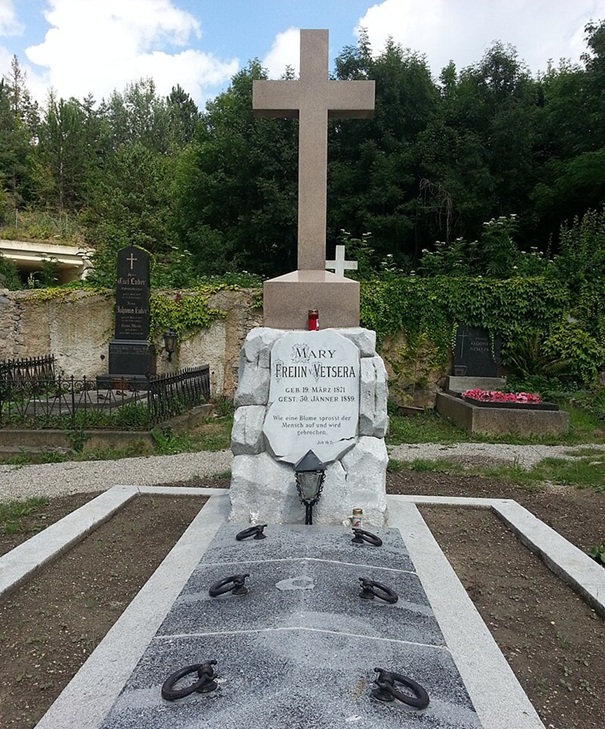
Above: Mary Vetsera's tomb in Heiligenkreuz Cemetery, to which she was moved from her temporary grave on May 16, 1889 (detail). Photo credit: Peterpol48, July 24, 2014.
Source: Wikimedia Commons

16. Mary's Burial (continued)
Every story generated by the Mayerling tragedy seems to have at least two contradictory versions and the same is true of Abbot Grünböck's reaction to the idea of burying Mary at Heiligenkreuz.
At the time of Mary's burial, police commissars Gorup and Habrda reported that "the Abbot, having read Count Bombelles's letter, after a short discussion most readily gave his agreement to the requested interment in the local cemetery, and, moreover, declared himself ready to have the required coffin made at the Abbey carpenter's shop and to have the grave made ready" (Judtmann 160).
However, years later Gorup wrote "I set out on my journey [to Heiligekreuz with Count Bombelle's letter] with a heavy heart, for I realized that the Abbot would refuse the Church's blessing and burial in a Catholic cemetery and that it would require all my so-called diplomatic skill to make him change his mind."
Gorup now claimed that "the Abbot not only raised objections to a quick burial but also made actual difficulties.... Only after protracted negotiations had the Abbot given his consent."
Gorup's later account rings the most true, if only because an abbot, asked on short notice to perform the quick and secret burial of a dead woman propped up in a carriage with a bullet wound to her head, might be expected to pose one or two questions.
Nobody seems to have thought of providing a medical diagnosis of insanity to excuse Mary's purported suicide. Did the police commissars divulge the secret of Mary's murder to make the Abbot change his mind?