




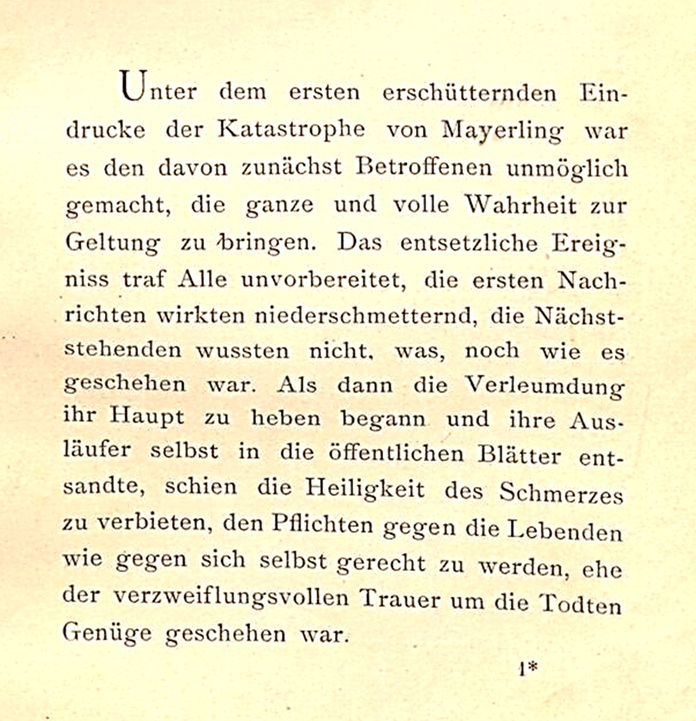
Above: The opening sentences of the printed version of Helene Vetsera's memorandum (detail). "Under the initial, shocking impression of the Mayerling catastrophe, those initially affected were unable to bring the whole truth to light. The horrific event caught everyone off guard; the initial news was devastating, and those who survived it did not know what had happened or how. When slander began to raise its head and send its spurs even into the public papers, the sanctity of pain seemed to forbid fulfilling one's duties towards the living as well as towards oneself before the desperate grief for the dead had been satisfied." Source: Osterreichische Nationalbibliothek (Austrian National Library).
18. Aftermath: Helene
Helene left Vienna at Franz Josef's request and went to stay in Venice, no doubt fearful of the consequences should she fail to comply.
Papal Nuncio Luigi Galimberti told the German ambassador Prince Heinrich Reuss that "The mother of the young girl is now in Venice, where, in a way, she is parading her daughter's disaster without making any secret of the romance. This throws a clear light upon this person, who claims to have received a promise that provided she disappeared and kept quiet before the burial, everything would be published later" (Judtmann 258-59).
Presumably this promise was to make public the true circumstances of Rudolf's suicide and Mary's death and thereby defend Helene and Mary from the vicious accusations that the rumour mill was churning out.
But if Helene hoped for vindication from Franz Josef she was sadly deceived. She returned to Vienna about mid-March, 1889 and repeatedly requested an audience with Franz Josef to present her case. She was repeatedly rebuffed.
In effect she had been banished from the Court, which had two consequences: one was to destroy her position in society, which depended on being received at Court, and the second was to lend credence to the rumours that were circulating about her and Mary.
In desperation, Helene decided to publish her defence in the form of a memorandum that ran to 86 printed pages. It detailed Mary's relationship with Rudolf and quoted Mary's last letters, as well as Hermine Tobis's account of her correspondence with Mary (Vetsera).