


Click on the picture to see a larger version.
The two-wheeled "jaunting car", "Irish car", "Dublin car", "outside car" or "outsider" was capable of carrying a driver and four passengers who sat back-to-back with their legs outside, over the wheels.
Source: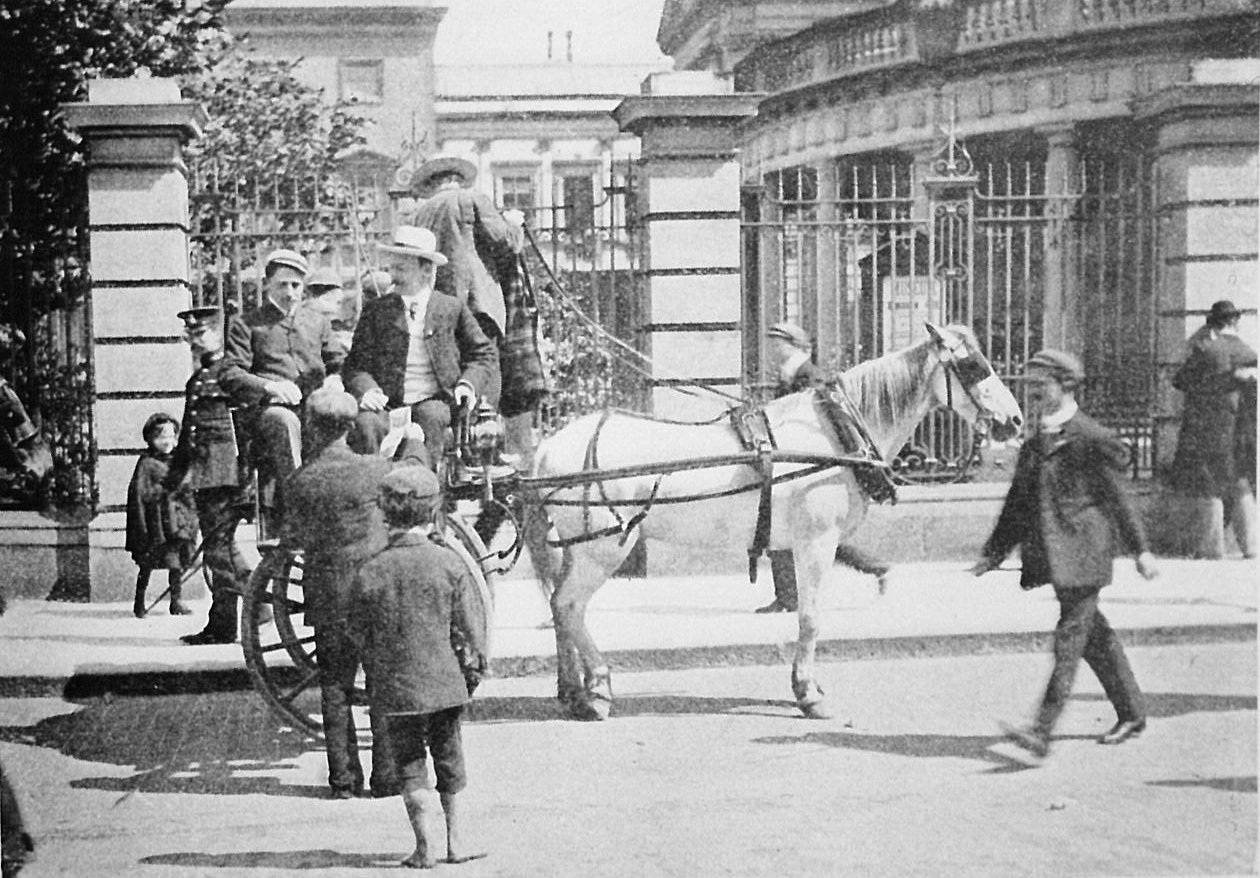
Tourists outside the Dublin Museum. Photo by Lafayette.
Outing magazine, vol. XLV, December, 1904, p. 295.
Vance Thompson's Cab Drivers / 24
How Pat Travels / 3
The mysterious Lawler I never saw, for when I went to King's Inn Street the good wife told me he was asleep, but Lawler's mare and I (with Barney) covered many a league in Dublin and the lands thereby, even unto Drogheda and the Valley of the Boyne. And with Barney I visited the Car-Owners Association Rooms, which are at 107 Talbot Street, and had more than a word with Fred Field, the president; saw, too, the building of the car and � Oh, 'twas a gran' night! � danced the "Humors av Glynn" at the jarvey's ball. And of these things I write � even as I write I can hear the squealing of the pipes and the rhythmic feet t'umpin' the flure. Oh, boys of man, it was a gran' night! But let us go soberly about our business. The Irish "outsider" is the most whimsical contrivance for getting about in that ever man devised. It consists of two high wheels, with a let-down seat over each wheel and a front porch for the driver. If there be only one passenger, the driver takes the other side in order to preserve the balance of the cranky vehicle. With two passengers he sits on the front seat; with three he takes a side-seat and joins, in a friendly way, the party. And here let one thing be said: In England there is more servility than service; in Ireland there is service and no servility. The Irish servant � public or private � will guide you, protect you, rob you, it may be, advise and comfort you; but it never occurs to him that he owes you the slightest measure of servility. If he approves of you he will treat you with friendly good nature and if he does not he'll try and educate you into a proper frame of mind. He may blarney you, for his sense of humor is keen, but who looks for the smug servility of the English "man" has far to seek. Kelt or Gael or Basque are alike in this. In Spain I had a servant, a slim, hardy, upstanding lad from the Basque country of Guipuzcoa. There were days of hard travel and hard work; never was a "man" quicker to foresee and readier to serve. Every night when he took himself off with my boots Jos� straightened himself up, looked me in the eye, said good-night and shook hands on it. There is a little of that ineradicable sense of equality in every Irishman. 'Twas in Barney O'Hea or I had niver danced the "Humors of Glynn" with a light-stepping girl.