


Click on the picture to see a larger version.
The jaunting car is a conspicuous part of the Dublin street life portrayed in James Joyce's Ulysses. See Get Ready for Bloomsday!
Source: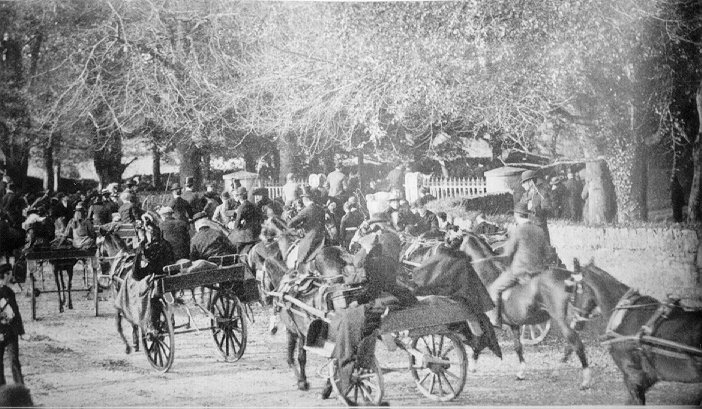
Following the Course of the Hounds in Jaunting Cars Along the Road. Photo by Lafayette.
Outing magazine, vol. XLV, December, 1904, p. 300.
Vance Thompson's Cab Drivers / 28
How Pat Travels / 7
The Saxon imagination has never quite compassed the Irish character. To men of Teuton tradition and habits of thought he will always be more or less of a puzzle, this Kelt, at once visionary and practical, at once sad and merry, astute and simple. Hard work is not the handle he takes hold of the world by, and yet there is no one so laborious. Under the divine laziness of the Kelt there is a turbulent fund of activity. If he is an idealist � always knocking his raw knuckles against iron doors � there is none keener at a bargain. The hiring of an outside car goes beyond mere business into art. In Dublin, to be sure, there is no wide range of discussion. A sixpenny course, is, after all, a sixpenny course, boggle at it as you will, and eighteen pence an hour is not a flexible fare; still the smart Dublin lad does wonders, considering the limited opportunity. It is with the alien, of course, that he is at his best. With joking and blarneying he accomplishes a great deal. He is, as I have said, no mere driver; lolling beside you on the car he is guide, companion, friend; his jocular, epigrammatic countenance is at your shoulder; he gets the whiff of your pipe; and, no matter how thick the Saxon dignity be crusted on you, 'twill be chipped off in the first half hour and you will find yourself as chummy as two girls, sitting on the floor, taking down their back hair. Bargaining under these circumstances is quite impossible. You can't quarrel over a beggarly half-crown with the "dacent," merry lad who has taken you to his heart; the result is that you spend more money that way in Dublin than in any old-world city. But it is when you take a car in the country that you really begin to understand the Irish jarvey. No civic regulations trammel his optimistic imagination. The miles that spin along by glen or wooded hills or mountain tarn or bleak bog-side, are infinite in possibilities. The reckoning runs faster than the stout, little horse in the shafts. The Irish mile is not as other miles are. It is no measured distance. It is a vague fragment of the fourth dimension of space. And so you pay in proportion to your driver's imaginative faculties. Why not? I had rather pay for long-distance poetry than for mere dirty miles of jaunting. It is not for me to discuss the Irish troubles, but it is safe to say that poverty is at the root of them all, and he who leaves his share � or a bit more than his share � of alien gold behind him is doing a rare good work. And what more profitable bargain can the Saxon make than exchanging his money for Irish salmon, white trout, gillarroo, grouse and snipe; for the air of mountain, lough or bog; for the wild ride on the rocking car and the joke or "dhrame" of the lad who drives? Upon my word I know not. As for the jaunting-car itself, there is no neater vehicle for the country-place and nothing smarter for the park. There should be more of them in the Ireland-over-sea. [The End]