


Click on the picture to see a larger version.
"There are nearly twenty ferries across the Grand Canal and the Giudecca. These are the traghetti. In one sense they are like the cab-stands or cab-ranks of cities built upon land; in another sense they are the unions or guilds of the gondoliers.... In the wooden shelter houses of the traghetti the guild meets and decides all questions of hours of work and choice of station."
Source: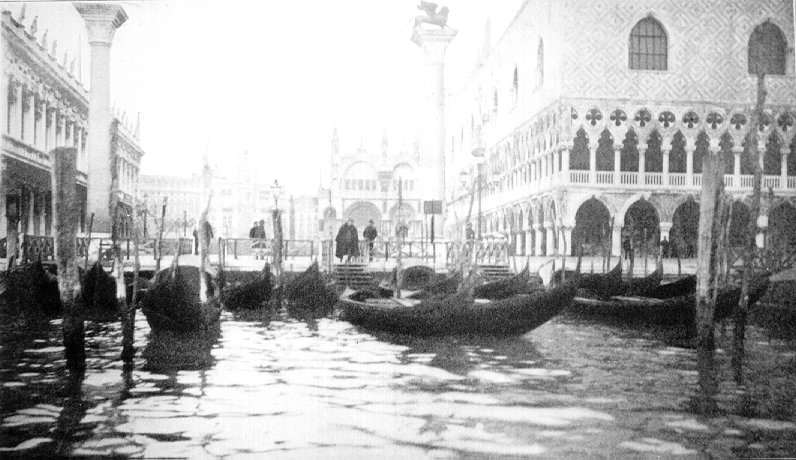
The principal traghetto (ferry) � Piazza San Marco. . Photo by Gribayedoff.
Outing magazine, vol. LI no. 6, March, 1908, p. 646.
Vance Thompson's Cab Drivers / 42
The Gondolier of Venice / 3
The Boat and the Building of it "Giuseppe," said I, "I would fain see the building of a gondola � to which of the squeri should we go?" It was an important question; Giuseppe debated it in his mind, as he swayed to the oar � a slim, brown, muscular young man, graceful as a panther, handsome as a tenor in his red costume of the Castellani. "The squero of San Trovaso," he said at last. We glided past the parish church and the camps with trees (nowhere is green so green as in this water-city) to the building-shed, where lay dozens of gondolas, side or bottom up, basking in the hot sun, their noses in the water. A huge pitch-kettle bubbled, sending up coils of thick smoke and spreading an acrid odor. Busy men, with naked breasts and legs, hammered and sang. It was the birthplace of the gondola. In the shed were four posts within which the gondolas are built, each on the same pattern. The length is thirty-two feet. One was well on toward completion, the oaken stern and bow posts set, the cherry ribs laid down, the walnut deckings at stern and bow in place; it was a thing of strength and beauty. Walled and bottomed with pine, floored and decked over, the gondola, so far as its water-going qualities are concerned, is complete. In this state it may be bought for twenty or thirty dollars � a mere dainty black hull � and all the other fittings must be bought by the gondolier, or rented, elsewhere. Of first importance are the two twisted oarposts, against which the beechwood oars are laid in the sculling. A blacksmith furnishes the iron-work for stern and bow. The steel blade, or beak, on the prow is usually an heirloom, or at least it has come down the years and few of them are made nowadays. This, too, is true of the brass sea-horse and brass hands which uphold the long black ropes of the arm-rests. Of them the gondolier is more than fond. They are individual to him as babies to a mother. They are the monuments of his race, carved of old and worn by the polishing of countless hands; they have come down the generations of gondoliers.