


Click on the picture to see a larger version.
"We glided... to the building-shed, where lay dozens of gondolas, side or bottom up, basking in the hot sun, their noses in the water. A huge pitch-kettle bubbled, sending up coils of thick smoke and spreading an acrid odor. Busy men, with naked breasts and legs, hammered and sang. It was the birthplace of the gondola."
Source: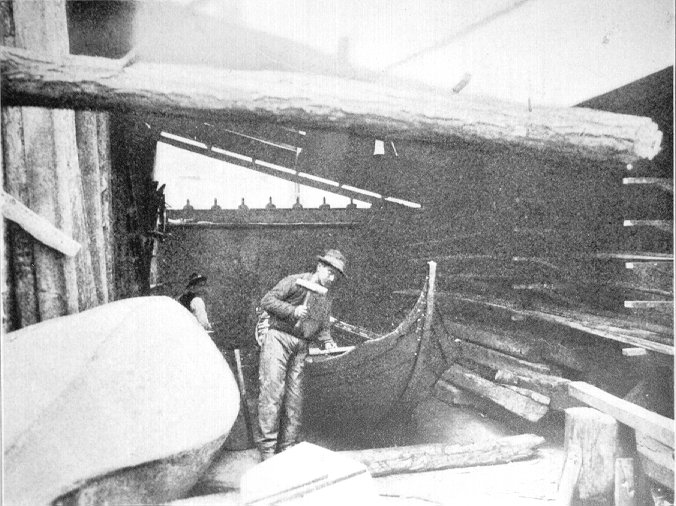
The builder. Photo by Gribayedoff.
Outing magazine, vol. LI no. 6, March, 1908, p. 648.
Vance Thompson's Cab Drivers / 44
The Gondolier of Venice / 5
The Gondolier and his Guild There are nearly twenty ferries across the Grand Canal and the Giudecca. These are thetraghetti. In one sense they are like the cab-stands or cab-ranks of cities built upon land; in another sense they are the unions or guilds of the gondoliers. Thus our friend Giuseppe is a member of thetraghetto of San Barnabe on the Grand Canal. It was there he took me to meet his good old father, a veteran of the beechen oar, Antonio, and his brother, the mighty prize-winner, Giovanni. In a littletrattoria, in the shade of the church, we toasted each other in pale, blond beer � the foreigner and a dozen members of thetraghetto. And the foreigner learned these things: The police, of course, license the gondolas, and, by various ordinances, govern the life of the gondolier. His real laws, however, are those of his guild. In the wooden shelter houses of thetraghetti the guild meets and decides all questions of hours of work and choice of station. Thus, those of St. Barnabe, have each a day off every week. One of them, in turn, works twenty-four hours at a stretch. If one of the fraternity falls ill he is cared for out of the public purse, and in case of death his brothers carry him to the grave. Stanch brothers, close-knit in friendship and their work, they are perhaps the last representatives of the good old medieval crafts of Venice. Thrifty men, and sober and laborious. Let us bury, once for all, the fanciful legend that these brown fellows are tinseled heroes out of what comic opera I know not. They do not wander in the moonlight, chanting the strophes of Dante. They are hardy lads, wholesomely ignorant of literature, fathers of many children, good husbands and matter-of-fact money-getters. On the whole I know no finer class of men than these simple watermen of the lagoons, the three rivers and the canals of Venice. In the season they charge seven francs a day; at other times you may have as fine a gondola and as skillful a gondolier as you can wish for five francs a day; their average earnings are far less, two francs or three. But then life in Venice is simple. For thirty-five dollars a year one may have five or six rooms in a good quarter of the town; and a little fruit and polenta, or fried fish, or an onion and a crust of bread, thin wine from Padua, make existence a pleasant thing. The gondolier has money in the bank and his life is good � here in white and purple Venice, the city of song and the sea.