
Featured items for managers
- Price wars are rare in the taxi industry but history does offer an example from 1949 in Hawthorne, California. Rates dropped from 30-cents per mile to an unsustainable flat rate of 10-cents per ride. The winner of the price war was the company that threatened to lower prices to just 1-cent per ride but who in fact reduced his prices by the least amount of all the competitors. The author applies lessons from the taxi price war to resolving real wars. Taxicab Rate War: Counterpart of International Conflict (free JSTOR subscription required.)
- A manager's first line of defense against high-risk drivers is the driving history. How to Read a Driver License Print-Out.

A perfect print-out
- RideCab WP is a low-cost booking platform for single-owner drivers, small fleet cooperatives and airport shuttles. The WordPress plugin lets operators own their own booking flow, customer data, and revenue.
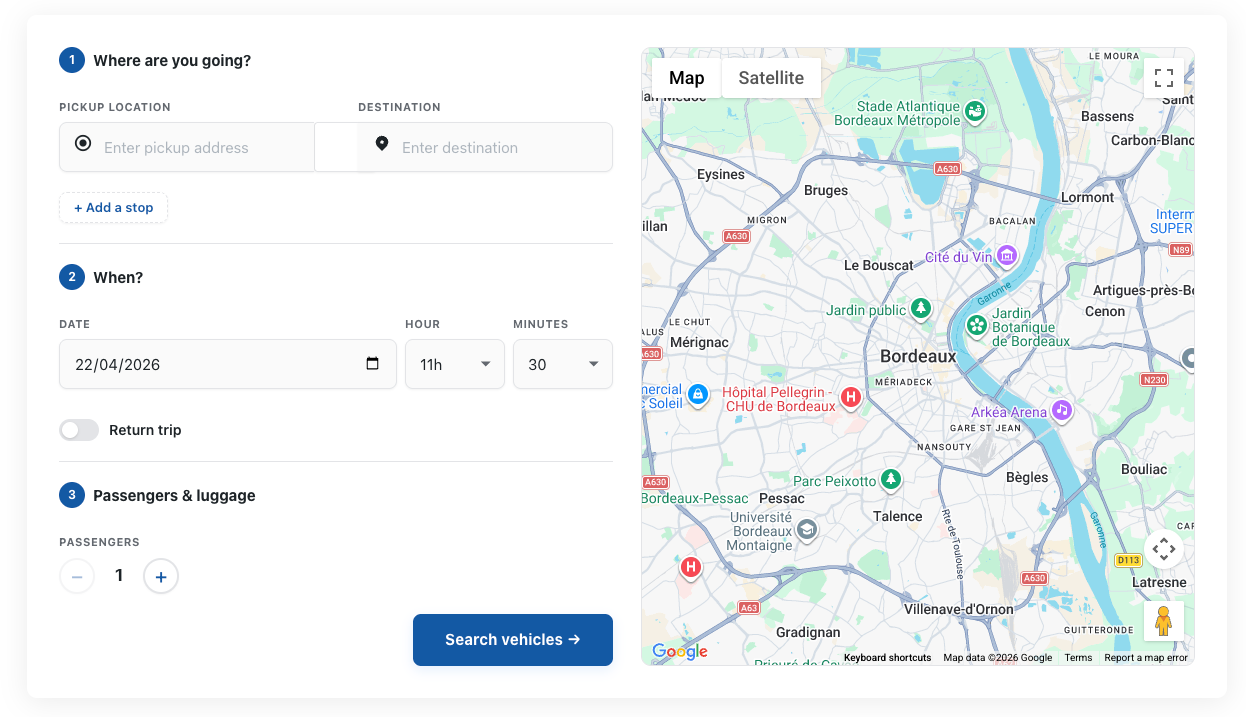
RideCab platform screenshot
- Download this Taxicab Rate-of-Fare Designer, an XLS worksheet that allows easy design, comparison and graphic charting of any two traditional taxicab rates of fare based on time and distance. The worksheet opens with the Excel spreadsheet program. See also NIST Handbook 44 - Taximeters Code which describes the U.S. requirements for accurate measurement and transparent calculation of metered taxicab fares. This technical document underlies important consumer protections for taxicab customers.

A chart comparing San Francisco's 2003 rate of fare with an alternative rate of fare
- Managing in the Aftermath of Disaster: What do you do when tragedy strikes and the phone is ringing off the hook? Read this thought-provoking account of what may be expected of a manager in times of crisis. Diamond Taxicab Dispatch Services general manager Jim Bell recounts the events following the death of driver Tahir Khan in a Toronto car wreck that captured the attention of the national media.
- Notes, Quotes and Anecdotes: this delightful and often hilarious collection from researcher Norman Beattie is a goldmine for speakers
- YouTube Video: A professional shows how and why to disinfect and clean the interior of a car

San Francisco Medallion Reform
- The Municipal Transportation Agency adopted an overhaul of its medallion regulations in February 2010. The reforms allow for the sale at a fixed price of a limited number of taxicab medallions by the city and by medallion holders who are disabled or who are over 70 years old. (125KB PDF)

Deputy Director of Taxi Services Chris Hayashi (left) and MTA Executive Director Nat Ford (right) look on as seller Mildred Megarity transfers her taxi medallion to buyer Ahmad Sidaoui on August 4, 2010. It was the first sale of a taxi medallion in San Francisco for 33 years. See more photos and a write-up on Ed Healy's blog. Photo courtesy of Ed Healy.
- The San Francisco Taxicab Industry: An Equity Analysis, June 2006 report prepared for SF Mayor Gavin Newsom and SF Supervisor Sean Elsbernd, from The Richard and Rhoda Goldman School of Public Policy at the University of California, Berkeley. The Executive Summary to the 45-page report states in part: "We believe a system permitting the sale of medallions (transferability) would provide a more equitable and improved taxicab industry if implemented within specific structural parameters." (477kb PDF document).
- San Francisco Permit Holders versus Taxi Commission, July 2002 California Appellate Court decision affirming the legality of a driving requirement for some medallion holders, with possible exceptions (40k PDF)
- San Francisco Superior Court 1995 decision in Joseph Tracy et al. vs. Yellow Cab Cooperative et al. requiring defendant cab companies to return security deposits to drivers, and permanently enjoining companies from challenging driver claims for Workers' Compensation and Unemployment Insurance benefits on the basis of independent contractor status. (3.15MB pdf)
San Francisco Ballot Measures 1978 - 2007
Taxi regulation in San Francisco was heavily influenced by a corporate meltdown in 1976 that led to a year of scarce taxi service and a controversial permit-trading deal in City Hall. See Taxis and SF Labor History for a brief summary of the crisis. In the wake of the crisis, a pair of competing taxi reform measures appeared on the ballot submitted to voters in 1978. Proposition K won with almost 51% of the vote and has shaped every aspect of the taxi business since that time.
The voters have been asked to revisit the issue numerous times since 1978. Propositions D in 1998 and A in 2007 won approval, while eight other propositions lost.
All the documents in this section are extracts from the ballot handbooks mailed to voters prior to the elections. They are in PDF format with file size under 1MB except as noted.
- Proposition J of June 1978 competed with Prop K but lost.Proposition K of June 1978 won with almost 51% of the vote (80,570 yes and 77,481 no votes). These documents include the official ballot statements and the published arguments pro-and-con. See also the complete legal text of Propositions J and K.
- Proposition M of November 1979 sought to restore transferability of permits. This document includes the official ballot statement and the published arguments pro-and-con. See also the complete legal text of the proposition.

- Proposition P of November 1981 sought to repeal Prop K and transfer regulation to the Board of Supervisors. This document includes the official ballot statement and the published arguments pro-and-con. See also the complete legal text of the proposition.
- Proposition P of November 1988 sought to repeal Prop K, but would have retained key elements such as non-transferability of permits. This document includes the official ballot statement and the complete legal text. See also the paid arguments pro-and-con that were published along with the proposition.

- Proposition Y of November 1993 sought, among other things, to increase the number of permits and add new types of permits. This document contains the ballot statement, the arguments pro-and-con, and the complete legal text.
- Proposition I of November 1995 was a bid by United Taxicab Workers to place a limit on cab rental fees (gate control) and to establish a centralized dispatch system. This document contains the ballot statement and the arguments pro-and-con. See also the complete legal text of the measure.

Courtesy of Dennis Kiernan. See a larger version of this campaign ad.
- Proposition J of November 1996 would have allowed the sale of permits, established gate control and limited permits to drivers with at least five years experience. It would also have allowed for a type of part-time permit. This document includes the ballot statement, the arguments pro-and-con, and the complete legal text. (1.25MB)
- Proposition D of November 1998 established the Taxi Commission. It was the only taxi-related ballot measure to pass after Prop K in 1978. This document includes the ballot statement, the arguments pro-and-con, and the complete legal text.
- Proposition M of November 2000 would have authorized the issuance of various kinds of special purpose taxi permits, and allow them to be issued to more than a single individual. Prop M would also have set 800 hours as an annual driving or operating requirement. This document includes the ballot statement, the arguments pro-and-con, and the complete legal text. (1.2MB)

Courtesy of Dennis Kiernan. See a
larger version of this campaign ad.
- Proposition N of November 2003 was a bid by PDA (now known as the Medallion Holders Association) to prevent revocation of permits due to disability. This document includes the ballot statement, the arguments pro-and-con, and the complete legal text. (3.9MB)

-
Proposition A of 2007 passed by a vote of 80,786 to 64,346 (55.6% to 44.4%.) See the official ballot statement with arguments pro-and-con, and the full text of the measure.
The measure relates to the Municipal Transportation Agency, which oversees the Municipal Railway and the Department of Parking and Traffic. It contains the following section, which provides a framework for revamping taxi regulation in San Francisco.
"The Board of Supervisors shall have the power, by ordinance, to abolish the Taxi Commission created in Section 4.133, and to transfer the powers and duties of that commission to the Agency under the direction of the Director of Transportation or his or her designee the Board of Directors. In order to fully integrate taxi-related functions into the Agency should such a transfer occur, the Agency shall have the same exclusive authority over taxi-related functions and taxi-related fares, fees, charges, budgets, and personnel that it has over the Municipal Railway and parking and traffic fares, fees, charges, budgets, and personnel. Once adopted, Agency regulations shall thereafter supercede all previously-adopted ordinances governing motor vehicles for hire that conflict with or duplicate such regulations."
The transfer to the MTA from the Taxi Commission happened in March 2009. Regulation moved into the hands of the Municipal Transportation Agency's Division of Taxis and Accessible Services. Numerous substantive changes have followed, notably a pilot program for the sale and transfer of taxicab medallions.
New York City
- Medallion sales and foreclosures are recorded on the Taxi and Limousine Commission website along with nominal medallion prices. The TLC advises that the recorded prices may not reflect actual market conditions.
- Researchers from MIT and other institutions examined data on 150 million NYC taxi rides and found vast potential for greater efficiency through app-based shared ride trips. Their report, Quantifying the benefits of vehicle pooling with shareability networks is available for free download from PNAS - September 2014.
- Kareem Haggag and Giovanni Paci authored a discussion paper for the Department of Economics at Columbia University titled Default Tips. The March 2013 study examined 13 million credit card transactions in New York City taxicabs. The authors determined that the default tips suggested to passengers on rear-seat terminals have a large impact on tip amounts. Generally tip amounts are higher, but the authors "highlight a potential cost of setting defaults too high, as a higher proportion of customers opt to leave no credit card tip when presented with the higher suggested amounts."
- Taxi '07: Roads Forward, a comprehensive 150-page vision for New York City taxis in the next decade. This beautifully illustrated book in PDF format is another outstanding taxi publication from the Design Trust for Public Space produced in conjunction with the Taxicab and Limousine Commission. Highly recommended.

-Courtesy of the Design Trust for Public Space
The MiniModal concept taxi for NYC by Hybrid Product Design + Development. It features large glass windows and roof panels to offer passengers better views. The MiniModal is one of several fascinating design innovations emerging from the exhibit Rethinking New York City's Moveable Public Space at Parsons The New School for Design from November 2005 through January 2006.
California Public Utilities Commission
The California Public Utilities Commission began proceedings in 2011 on TNCs including Uber and Lyft. As of mid-2026 the proceeding continues to generate filings from dozens of interested parties. The more than two thousand publicly accessible documents include exhaustive legal discussions of virtually every aspect of Transportation Network Company regulation. The documents are accessible through the CPUC Proceedings Search Page. Enter proceeding number "R1212011" to see the list of documents.
The California Public Utilities Commission issued its Decision Adopting Rules and Regulations To Protect Public Safety While Allowing New Entrants To The Transportation Industry on September 23, 2013 in San Francisco. Commercial "rideshare" operators such as Lyft, Sidecar and UberX will be awarded a new class of permit as "Transportation Network Companies." The regulations are largely self-enforced and allow TNCs to dispatch an unlimited number of non-commercial personal cars in commercial for-hire passenger service. TNC drivers do not need a for-hire permit. Applications for a rehearing of the decision were filed on October 23 by both Uber and by the Taxicab Paratransit Association of California.
Many states issued formal notices warning about inadequate insurance in ride services such as those operated by Uber and Lyft. Click on the following links for twenty examples: California, Connecticut, District of Columbia, Idaho, Iowa, Kansas, Louisiana, Maryland, Massachusetts, Michigan, Minnesota, Nebraska, Nevada, New Mexico, New Jersey, Ohio, Pennsylvania, Rhode Island, South Carolina, Tennessee and Utah.
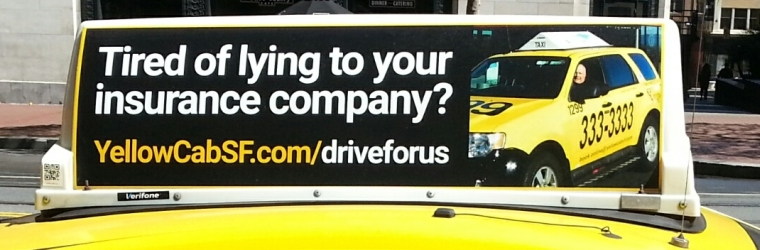
Photo: August 2016 driver recruitment ad atop a San Francisco taxicab was directed to TNC drivers.
Early Response To Uber and Lyft
- The Cost of Convenience from the Stigler Center for the Study of the Economy and the State at the University of Chicago Booth School of Business, October 2018. "The arrival of ridesharing is associated with an increase of 2-3% in the number of motor vehicle fatalities and fatal accidents. This increase is not only for vehicle occupants, but also for pedestrians."
- Uber State Interference: How Transportation Network Companies Buy, Bully, and Bamboozle Their Way To Deregulation by Joy Borkholder, Mariah Montgomery, Miya Saika Chen and Rebecca Smith. This January 2018 report from the National Employment Law Project provides in-depth case study analyses of TNC-caused political crises in Florida, Pennsylvania, Texas, and Washington. See also Uber’s Political Program in the States, an article describing the report.
- University of Washington School of Law Research Paper The Taking Economy: Uber, Information, and Power by Ryan Calo and Alex Rosenblat was published in the Columbia Law Review. March 2017
- San Francisco and Los Angeles District Attorneys announced a $25 million settlement with Uber and a permanent injunction prohibiting the company from making misleading statements regarding the safety of its transportation services or the background checks of its drivers. The December 2014 complaint in California Superior Court alleged misrepresentations regarding background checks, improper use of an app to measure distance for fare calculation, and unlawful operation at airports. See also the DAs' First Amended Complaint, August 2015.
- A cease and desist order from the South Carolina Public Service Commission to Uber for illegal operation was followed the next day by a letter on behalf of Uber from the governor expressing "intense disappointment" with the Public Service Commission. January 2015.
- The San Francisco Taxicab Workers Alliance prepared a white paper, San Francisco Can and Should Regulate Taxi-Like Ride Services, presented to SFMTA 2015. The paper cites sections of the California Public Utilities and Vehicle codes that allow some regulation by local agencies even when the state has exercised primary jurisdiction.
- In November 2014 Uber ignited a firestorm of outrage when its senior vice president Emil Michael suggested that the company spend a million dollars to dig up dirt on journalists who are unfriendly to Uber. His words were seen as focused on journalist Sarah Lacey who had previously criticized the company for sexism and misogyny. The comments spawned hundreds of news reports, key among them being the initial article by BuzzFeedNews editor Ben Smith which was viewed more than 700,000 times.
- An Uber controversy regarding customer privacy erupted in November when senior executive Josh Mohrer used the company's GodView technology to track the movements of journalist Johana Bhuiyan.
- San Francisco online journal 48Hills published: Uber’s tax-avoidance strategy costs government millions. How’s that for “sharing?” July 2014.
- California PUC President Michael Peevey wrote a letter to Uber's Travis Kalanick expressing his disappointment over Uber's flouting of CPUC regulations, June 10, 2014.
- An NBC investigation into "rideshare" background checks appeared in three different reports from Chicago, Los Angeles and San Francisco. The reports found that lax background checks by Uber led to the hiring of unsuitable drivers.
- KQED in San Francisco published a report on TNC safety and inspections: What UberX Drivers Are Saying About Their Training and Safety Issues February 20, 2014. The report found that vehicle inspections consisted of merely emailing a photo of the vehicle.

Internet Advocacy ’Uber’ Alles: What Uber-Fans Accomplished in Boston & What It Means for Urban Democracy & Local Government. This insightful paper by Harvard law school student Molly Cohen is must-read for taxi industry participants who face organized social media campaigns by wealthy elites. Ms. Cohen presented her views at the October 2013 TLPA conference in Boston.
Dynamex Operations West, Inc. v. Superior Court
The California Supreme Court has established a new test to determine if a worker is an employee or an independent contractor. All workers are presumed to be employees unless three conditions are met. The worker must be free from control and direction in the performance of the work, and must perform work that is outside the usual course of the hiring entity’s business, and must be engaged in an independently established trade or business. April 2018.

This ad for San Francisco taxi service shows a very early Renault taxicab. Both the driver and passenger compartments are mostly exposed to the elements.

Yellow 831 begins the steep descent down California Street toward the San Francisco Financial District.

Red arrows indicate turn restrictions for private vehicles at intersections along San Francisco's pedestrian-friendly Safer Market Street, August 2015. Taxis retain full access to the busy thoroughfare along with buses, bikes and delivery trucks.

California Assembly Member Susan Bonilla became the object of negative political ads when she introduced the first legislation that established insurance requirements for Uber. Governor Brown signed her legislation, Assembly Bill 2293, into law in September 2014.
- The World Bank, Washington, DC published Regulation of Taxi Markets in Developing Countries: Issues and Options, a February 2005 paper by Kenneth M. Gwilliam which examines the reasons why fares tend to rise when taxi markets are deregulated.
- Taxicab Deregulation and Reregulation in Seattle: Lessons Learned, September 2001 report by Craig Leisy, Manager of the Consumer Affairs Unit for the City of Seattle. From the report: "The City of Seattle regulated rates and entry in the taxicab industry beginning in 1914. The taxicab industry was deregulated in 1979 because it was believed that competition would provide the public with improved service and lower rates. In fact, service quality declined and rates were often higher. Subsequently, the taxicab industry was reregulated starting in 1984. Initially, rate ceilings were established and later a moratorium was placed on issuance of new taxicab licenses. Seattle, like nearly all of the other cities that experimented with deregulation, eventually returned to regulation of entry and rates." Available from the International Association of Transportation Regulators.
- "Analysis of Taxicab Deregulation and Re-Regulation" - This 1993 Price Waterhouse study concludes that, "The effects of taxi deregulation have ranged from benign to adverse. This is a departure from the experience with deregulation in other industries, and is influenced by taxi market imperfections which reduce or remove incentives for price and service quality competition. Consequently, most cities which had fully deregulated taxi service have since reverted to some form of control over market entry." The paper is available on the Colorado.gov website.
- Paul Dempsey's 1996 article Taxi Industry Regulation, Deregulation & Reregulation: The Paradox of Market Failure explores the collision of economic theory with empirical reality.
- The Tragedy of the Commons by Garrett Hardin (1968) in Science magazine is one of the most-cited articles ever. It's insights about over-use of shared spaces remain relevant fifty years later as tens of thousands of "rideshare" vehicles swarm onto city streets around the world.
- "The Economic Reasons for Price and Entry Regulation of Taxicabs" in Journal of Transport Economics and Policy, September 1975, Vol. 9, No. 3, Page 268, by C. Shreiber. "In a free market the charges for taxicabs tend to be high. Regulation in New York City has not been properly designed to achieve economic efficiency; but abolition of the present restriction on entry will increase congestion and pollution and attract more passengers from public transport."
- "The Economic Reasons for Price and Entry Regulations of Taxicabs. A Comment" in Journal of Transport Economics and Policy, September 1977, Vol. 11, No. 3, Page 288, by R.B. Coffman. "A comment on the article in the September 1975 issue of this Journal, with the author's rejoinder."
- "The Economic Reasons for Price and Entry Regulation of Taxicabs. A Comment" in Journal of Transport Economics and Policy, January 1980, Vol. 14, No. 1, Page 105, by D.J. Williams. "A comment on the article and later rejoinder by Professor Shreiber, published in this Journal in September 1975 and September 1977."
- "The Economic Reasons for Price and Entry Regulation of Taxicabs: A Rejoinder" in Journal of Transport Economics and Policy, January 1981, Vol. 15, No. 1, Page 81, by C. Shreiber. "Professor Shreiber, author of the article and later rejoinder published in this Journal in September 1975 and September 1977, replies to the comment by David J. Williams which appeared in January 1980."
- "The Impact of Taxicab Deregulation in the USA" in Journal of Transport Economics and Policy, January 1987, Vol. 21, No. 1, Page 37, by R.F. Teal M. Berglund. "Deregulation of taxicabs in several US cities has not produced the expected benefits. The authors analyse the reasons for this failure, and make suggestions for future policy."
- "Price Regulation and Optimal Service Standards: The Taxicab Industry" in Journal of Transport Economics and Policy, May 1972, Vol. 6, No. 2, Page 116, by G.W. Douglas. "In a market of cruising taxis price competition is impracticable, and service (measured by waiting time) cannot be differentiated by customers' willingness to pay. This article examines the principles governing the setting of efficient prices to attain the maximum use of the service."
- "Deregulating Taxi Services: A Word of Caution" in Journal of Transport Economics and Policy, May 1995, Vol. 29, No. 2, Page 195, by J. Hackner S. Nyberg. "This paper studies pricing and capacity decisions in markets for phone-ordered taxicabs. Firms first choose capacities and then compete in prices. As firm demand increases, so does waiting time. This dampens competition and makes prices too high from the social point of view. Efficiency improves if firms choose large capacities. In a two-firm setting, equilibrium capacities are shown to be larger if both firms maximise total profits than if they maximise profits per cab."
- "Economies of Scale in the Taxicab Industry. Some Empirical Evidence from the United States" in Journal of Transport Economics and Policy, September 1983, Vol. 17, No. 3, Page 299, by A.M. Pagano C.E. McKnight. "There are economies of scale for very small taxicab firms, but over 75,000 trips per year average costs increase, so the curve is U-shaped."

For-hire vehicles include limousines and taxicabs. Regulations for each are challenged by commercial "rideshares" and other taxi-like services that claim exemption from regulation.
American Journal of Preventive Medicine
June 11, 2013
Effectiveness of Taxicab Security Equipment in Reducing Driver Homicide Rates
Cammie K. Chaumont Menéndez, PhD, Harlan E. Amandus, PhD, Parisa Damadi, BS, Nan Wu, MS, Srinivas Konda, MPH, Scott A. Hendricks, MS
(Am J Prev Med 2013;45(1):1-8)
From page 5 of the article:
"These data support the hypothesis that installing cameras in taxicabs results in a reduction in citywide taxicab driver homicide rates post-installation (seven times lower homicide rate) and compared to cities with neither cameras nor partitions (three times lower homicide rate). The data do not support the hypothesis that cities with partitions installed in taxicabs experience lower taxicab driver homicide rates than cities with neither cameras nor partitions. This is the first study to methodically collect data from a nationally representative sample of the largest taxicab cities over a 15-year time span that allows for comparison of rates pre- and post-installation of cameras."
See also a related article by the same authors "Cities with camera-equipped taxicabs experience reduced taxicab driver homicide rates: United States, 1996 - 2010"

"He's my best friend and he's my hero" said Sheree Kerner of her brother, New Orleans taxicab driver William L. Kerner IV. His death in a May 2011 robbery led to passage of SB 639 which elevated to first-degree murder the killing of a taxicab driver in Louisiana. The law became effective August 1, 2012.

Map of taxi depots (service providers) in the country area surrounding Melbourne, Victoria in Australia.
 UN Photo
Participants pose for a group photo at the Expert Group Meeting in Rio de Janeiro, May 2011, on the Greening of the Latin American Taxi Fleet.
Special Report: Greening Taxis in Latin America
Presentations from the Expert Group Meeting in Rio de Janeiro, May 2011 on Sustainable Urban Transport: Policy Options for Modernizing and Greening Taxi Fleets in Latin American Cities. The meeting generated a wealth of information from Argentina, Bolivia, Brazil, Chile, Colombia, Cuba, Ecuador and Mexico. The presentations also cover a wide range of topics including electric taxis in China, solar-powered bicycle taxis in Germany, motorized rickshaws in India, and greening in California and Korea.
Regulation, Deregulation and Reregulation
Journal of Transport Economics and Policy
These documents from the Journal of Transport Economics and Policy are available to users at institutions. (They used to be available to all for free, and may still be if you can figure out their web page!) Many of the articles published in the journal are of special interest to readers with a strong background in math.

Seatbelt reminder from the City of Auburn in New South Wales


