



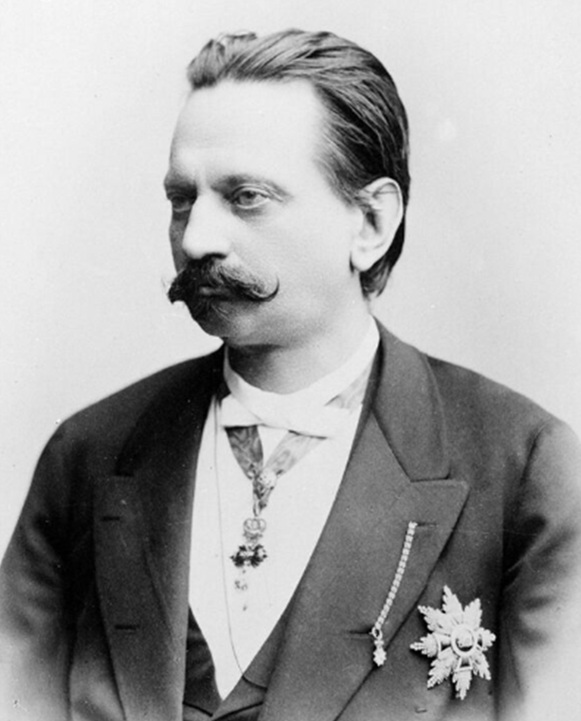
Above: Count Eduard von Taaffe (1833-1895), Prime Minister of Austria (detail)
Source: Osterreichische Nationalbibliothek (Austrian National Library)
4. The Police
The Vienna police department was the responsibility of two men who worked closely together. The first was Austria's prime minister, Count Eduard von Taaffe, and the second was Baron Franz von Krauss, Vienna's President of Police, who reported to Taaffe directly.
Taaffe was not only Franz Josef's principal advisor but also a boyhood friend. The two men were in agreement that Rudolf was a loose cannon, but Taaffe carried his resentment further and regarded Rudolf as a both a personal and political enemy. There was no love lost on either side; Rudolf had called Taaffe "the grave digger of Austria." (Judtmann, 319)
Ironically, Taaffe shared some of Rudolf's democratic ideals. His political downfall came in 1893 when he introduced a bill that extended the franchise and eliminated the property qualification for voters. The bill provoked such violent opposition among conservative elements in his own political party that he and his government were forced to resign.
Taafe and Krauss both shared Franz Josef's concern that Rudolf's flirtation with radical politics might lead him to commit an indiscretion that would cause a political scandal or provoke a public incident.
They both therefore had a strong interest in knowing what Rudolf was up to at all times, but Krauss had an even more compelling motive than Taaffe. As President of Police, Krauss was in charge of monitoring dangerous political elements in Vienna with a view to anticipating and preventing trouble before it erupted.
Rudolf's penchant for playing with fire was particularly worrisome for Krauss because he knew that if the Crown Prince's behaviour resulted in public embarrassment for Franz Josef, he himself would likely be held personally responsible.