



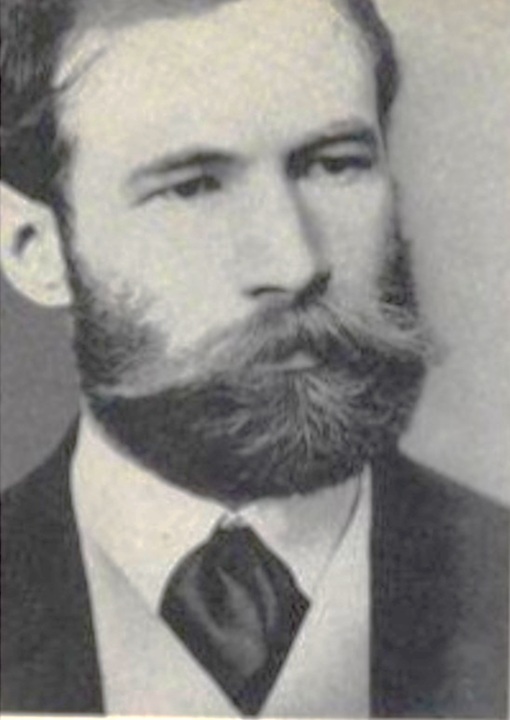
Above: Baron Franz von Krauss (1837-1919), President of Vienna Police
Source: Judtmann, before p. 81.
4. The Police (continued)
Krauss's fear was justified. In March, 1888, Queen Natalie of Serbia visited Vienna and in spite of Franz Josef's strict orders that there would be no public demonstrations, cheering crowds of Serbs poured onto the streets to greet her. Franz Josef was outraged and sent a telegram to Taaffe demanding that Krauss be fired (Judtmann 359).
Krauss kept his job, no doubt through Taaffe's intervention, but the incident explains why both Taaffe and Krauss were circumspect about interfering in royal business.
Krauss faced a number of strict prohibitions when it came to monitoring Rudolf or any other member of the royal household. He could not enter the royal palace (the Hofburg) or any other royal residence without an invitation. He could not interrogate palace staff, and he could not put Rudolf under overt surveillance.
Moreover, although Austria-Hungary was ruled by an autocratic emperor it was far from being a police state. Law-abiding citizens, including cab drivers like Josef, had legal rights that the police needed to be cautious about infringing. Krauss therefore had to resort to subtler means.
Given the strained relations between Rudolf and his father, and between Rudolf and Crown Princess Stephanie, the Hofburg was a nest of divided loyalties. It was not difficult to recruit a number of confidential informants from among palace staff who were willing to pass on information to the police, especially for pay.
Two more informants reported on Mizzi Caspar's meetings with Rudolf. One was a shadowy figure known as the procuress Wolf, who apparently carried on her pimping business without interference thanks to her usefulness to the police.
The second informant was Dr. Florian Meissner, a former police officer turned lawyer. He and Wolf must have got their information directly from Mizzi, and Mizzi more than likely knew that the information was going to be passed on to Krauss.
A special unit within Krauss's police department, the Police Agents Institute, supervised both undercover officers and paid informants.