




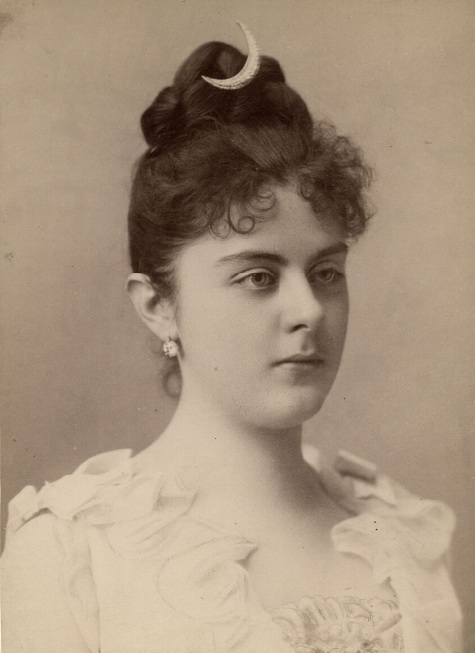
Above: Mary Vetsera (1871-1889).
Source: Osterreichische Nationalbibliothek (Austrian National Library)
8. The Black Iron Door (continued)
Helene Vetsera would have been doubly concerned about Mary's relationship with Rudolf because she herself had paid a price for succumbing to his devastating charm. In 1879, when she was 33 and Mary was eight, Helene was smitten by the 20-year-old Rudolf.
During an outing on horseback she flirted so blatantly with him that Franz Josef grumbled, "That woman's antics with Rudolf are outrageous – riding after him wherever he goes. Today she has even given him a present" (Judtmann 108).
Helene made herself the butt of gossip but since she was a married woman her position in society did not suffer. The experience taught Helene to pursue her extramarital romances a bit more discreetly.
Countess Marie would have been well aware of the danger that Mary was in. This made her treachery all the more cold-blooded. Her motive was purely selfish. She began by using Mary to ingratiate herself with Rudolf, but before long she proved that she was willing to sell Mary out for cash.
The Countess was chronically short of money. Her husband resented her gadding about and his tight grip on the purse strings kept her on a short leash.
To finance her stay in Vienna, the Countess used Mary to extract money from Rudolf. He gave her 25,000 florins at Mary's behest, no doubt because the Countess's presence in Vienna was very useful to him, but he refused to give her a further 10,000 florins to pay for a trip to Nice.
When Rudolf refused her the Countess pressured Mary into trying to borrow 6,000 florins from her personal maid. Not surprisingly (except perhaps to Mary and the Countess) the maid said she did not have that kind of money.