




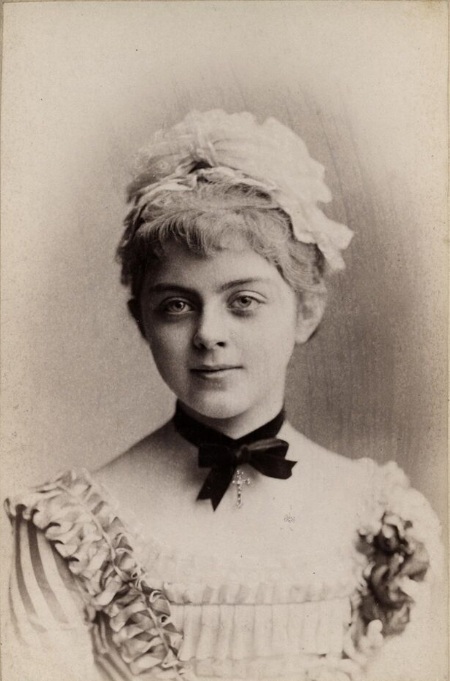
Above: Mary Vetsera (1871-1889) (Detail).
Source: Osterreichische Nationalbibliothek (Austrian National Library)
9. Suicide Plans
Rudolf had been openly talking of suicide for months and he must have toyed with the idea of a suicide pact with some willing woman well before he met Mary. The hopelessly infatuated teenager gave him the opportunity to act out his fantasy.
Mary may have had her own fantasy about suicide. Her French language tutor reported a conversation she and Mary had about a notorious murder and attempted suicide that took place in January, 1888. The couple involved were supposedly carrying out a suicide pact. The tutor was astonished at Mary's detailed knowledge of the incident and her evident fascination with it.
In any case Mary took Rudolf's suicide plans to heart almost from the beginning. Romantic notions of death pervade Mary's letters to her close friend Hermine Tobis, then living in England, who described their heart-wrenching correspondence in her own long letter to Mary's sister Hanna (Jilek).
"Once in December, she [Mary] wrote that she had been to see him again and that he had complained to her that he was so unhappy with his wife [Princess Stephanie]. 'This woman neglects me and her child,' he said, 'and only enjoys jewelry and clothes.'"
"If I could be his wife and give him an heir to the throne, how happy I would be! Or if we could live in a hut together! We always talk about it and are happy about it. But alas, it cannot be. If I could give my life to see him happy, I would do it with joy, for what does life matter?" "In January," wrote Hermine, "I received letters in which she wrote that she couldn't live without him, that he was her God, her everything. She implored me not to tell anyone, because if it came out, they would both die together in a place that no one knows about, after a few happy hours."
At some level Mary must have known as well as Helene and the Countess that she and Rudolf would never be husband and wife and that her affair with him was a serious breach of social mores that would expose her to condemnation and disgrace.
Perhaps Mary was well aware that she was committing social suicide and, from the beginning, saw actual suicide as a way of escaping the consequences.