




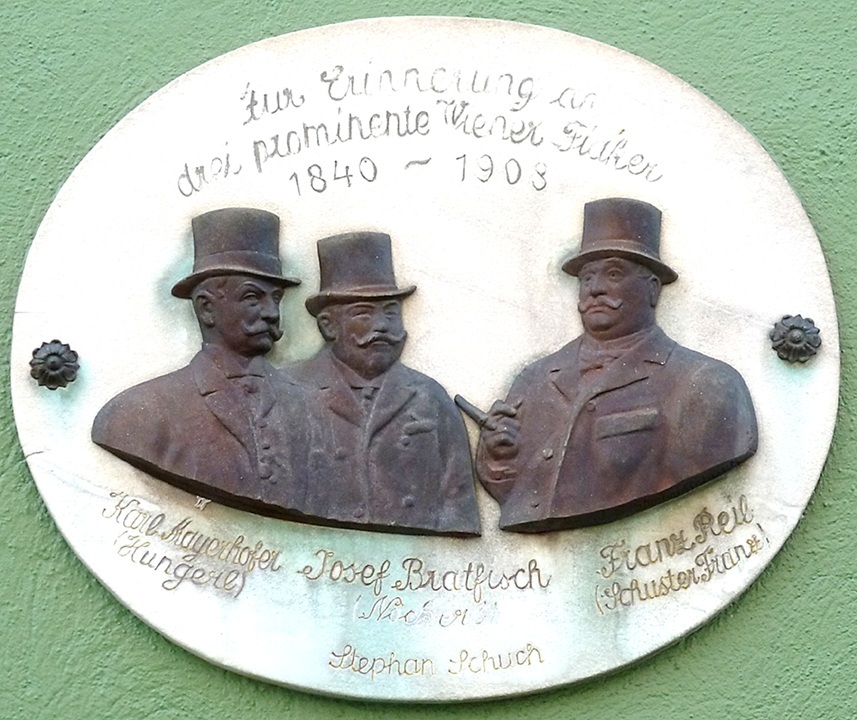
Above: Memorial plaque by artist Stephan Schuch located at Lacknergasse 60 in Vienna: "In memory of / Three prominent Vienna Cab Drivers / 1840 - 1908 / Karl Mayerhofer (Hungerl) / Josef Bratfisch (Nockerl) / Franz Reil (Schuster Franz) / (Stephan Schuch)." Source: Hedwig Abraham, Kunst und Kultur in Wien: Gedenktafeln in Wien: Josef Bratfisch (Art and Culture in Vienna: Memorial Plaques in Vienna: Josef Bratfisch).
21. Aftermath: Josef
Part of the reason why the Mayerling tragedy became so encrusted with myth and fantasy is that key witnesses kept silent while a multitude of outsiders scrambled to exploit what they knew, or thought they knew, or pretended to know.
The testimony of Josef Bratfisch, Johann Loschek, Count Hoyos, Prince Philipp, Dr. Heinrich Slatin, Mizzi Caspar and no doubt others either never came to light, or emerged only after a long delay.
Johann Loschek did not tell his story until 1928, when he was in his 80s, and then only at the behest of his son. Count Hoyos and Heinrich Slatin wrote accounts of what they knew, but delayed publication until after their deaths. The Hoyos account was not published until 1928 and Dr. Slatin's not until 1931. Apart from her statement to police about her last meeting with Rudolf (delivered to them by the procuress Wolf), Mizzi Caspar lived such an intensely private life that she practically disappeared.
Police President Baron von Krauss's "secret" file containing documents related to his Mayerling investigation was not discovered until 1955. Fritz Judtmann identified several important records that were deliberately destroyed or suppressed though some (such as Helene Vetsera's memorandum) were lucky enough to survive the efforts to destroy them.
As with everyone else connected with the Mayerling tragedy, gossip and rumours buzzed around Josef like a swarm of flies. The most persistent rumour was that Josef had been handsomely rewarded by Emperor Franz Josef for keeping silent about what he knew of Rudolf's and Mary's deaths.
For example, Egon Wollner, son of Josef's employer Leopold Wollner, told author Fritz Judtmann: "I am firmly convinced that Bratfisch received a major sum from the Court Chancellery as hush money, since shortly afterwards, to my own knowledge and according to my father's accounts, he started a business of his own" (Judtmann 358).