




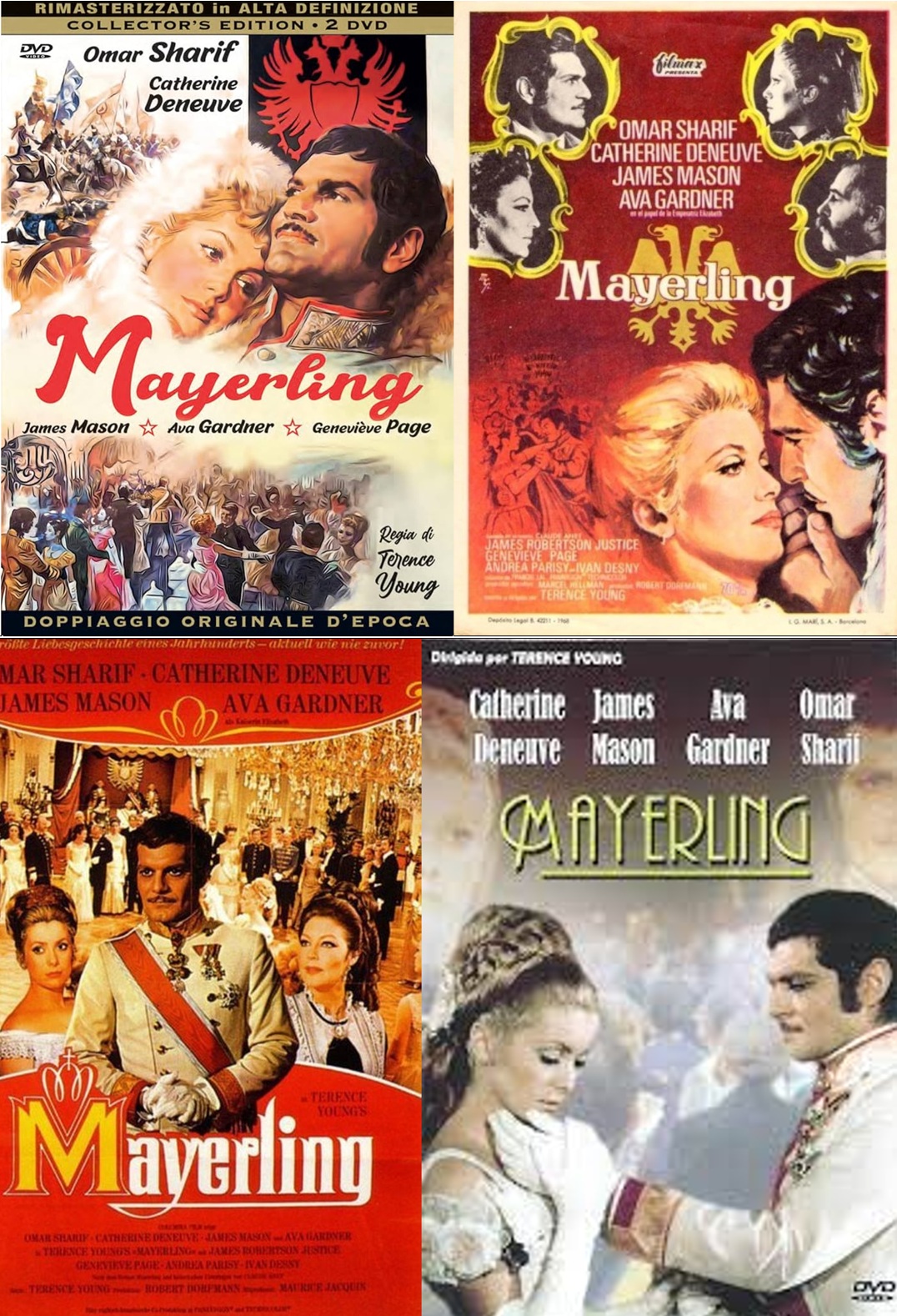
Above: Movie posters for Mayerling (1968): Romantic fiction overlays sordid reality. Sources: Clockwise from top left: Internet Movie Database; Amazon.ca; Cinematerial; Cinematerial.
22. Sources
Note: English language quotes from German language documents have been created using Google Translate.
Baedeker, Karl (Firm). The Rhine, from Rotterdam to Constance: handbook for travellers (Leipsic, 1892). Accessible online via Internet Archive. The Baedeker guides included "Money Tables" at the front for the currencies that travellers would encounter, offering approximate equivalents to U.S. dollars and British pounds. The table in this guide equates the Austrian florin to approximately 50 U.S. cents.
Budweiser Bote: unabhängiges Volksblatt für Südböhmen (Budweiser Bote: independent newspaper for South Bohemia), Vol. 9 no. 7 January 25, 1893, p. 6. "Mosaik: Der Nachlass des Fiakers Bratfisch ("Mosaic: The legacy of Fiaker Bratfisch"). Accessible online via Google Books.
Friedrich, Lars. Das neue Mayerling-Sammelsurium: Kurioses aus 25 Jahren Mayerling-Archiv (The New Mayerling Collection: Curiosities From 25 Years of the Mayerling Archive) (neobooks, 2014). Partially accessible online as a Google Books preview which includes several pages about Josef Bratfisch.
Hummelberger, Walter. "Maria Caspar und Josef Bratfisch: Biographische Notizen" (Maria Caspar and Josef Bratfisch: Biographical Notes) in Jahrbuch des Vereins für Geschichte der Stadt Wien (Annals of the City of Vienna Historical Society), vols 19-20, 1963-64, pp. 277-291. Accessible online via the Austrian National Library.
Dr.Hummelberger (1905-1995) was in charge of the weapons collection at the City of Vienna Historical Museum from 1947 until his retirement in 1973.
Illinois Staats-Zeitung, January 16, 1893, Page 12. (Funeral of Josef Bratfisch). Accessible online via Chronicling America.
Jilek, Katrin. "Ich konnte der Liebe nicht wiederstehen" ("I could not resist Love"), Austrian National Library, September 19, 2019. A blog article describing the letters and documents discovered during the audit of bank safety deposit boxes in 2015. Footnotes include links to digital documents on the Austrian National Library website, including Mary Vetsera's last letters written at Mayerling:
Judtmann, Fritz. Mayerling: The Facts Behind the Legend (London: George G. Harrap & Co., 1971). Translation by Ewald Osers of Mayerling ohne Mythos (Mayerling Without Myth), 1968. Accessible online via Internet Archive.
This book is the main source on which Fiakerlied is based. Dr. Judtmann (1899-1968) was a Viennese architect and stage designer. His interest in the Mayerling tragedy was triggered in 1957 after he was bequeathed a clock that reputedly once belonged to Emperor Franz Josef. While researching the clock's provenance in the Austrian State Archives, Judtmann discovered a hitherto unknown document relating to Mayerling. The document, dated October 18th. 1912, was a statement by Count Heinrich von Taaffe, son of Prime Minister Eduard von Taaffe, declaring that Mayerling papers entrusted to his father by Emperor Franz Josef for safe keeping "had been lost under mysterious circumstances while deposited with a Vienna lawyer" (Judtmann 5).
The Taaffe statement piqued Judtmann's curiosity about the whole Mayerling drama but as he began his research he realized that he was venturing into a murky jungle of myth, speculation, gossip, contradictory evidence and outright lies. The document that he found in the State Archives was symbolic of what he was going to uncover, and simultaneously fail to uncover.
"Almost as soon as I started to study the literature about the Crown Prince I found that, in spite of an almost bewildering multitude of publications, there are only a few works which deal with the subject in a serious manner on the basis of source research. Most of the books and articles are either essentially restatements of earlier publications or novelettish inventions, with the same legends and false claims passed on by one author to another." So began his ten-year quest that ended with Mayerling: The Facts Behind the Legend.
Judtmann's book is made up of twelve chapters in each of which he analyses the available evidence concerning a specific issue raised by the Mayerling tragedy. The book is a collection of case studies rather than a connected narrative. In the last chapter, "The Missing Documents," Judtmann describes the documentary evidence which is known to have existed but which was suppressed or which has otherwise vanished.
A Postscript brings Judtmann full circle. Judtmann had a lengthy correspondence with Heinrich von Taaffe, the author of the statement that Judtmann found in the State Archives, until Heinrich's death in July, 1967. A relative of Heinrich who inherited the von Taafe archives stated that they did not contain the "Mayerling papers" -- the papers that Emperor Franz Josef entrusted to Prime Minister Eduard von Taaffe. However, somewhat mysteriously, he told Judtmann that he believed these papers still existed but gave no reason for his belief.
"Our researches have shown us that the history of the Mayerling papers is one continuous chain of mystification, designed to obliterate the traces of the documents," wrote Judtmann. "It must be feared that the late Count [Eduard] continued this tradition by depositing the papers at some secret place -- unless Count Heinrich Taaffe destroyed them before his death."
Konhäuser, Antonia. Denkschrift (Memorandum). Accessible online via the Mayerling Forum web site. "The above simple recollection of my childhood memories is entirely true. Vienna, Thursday, April 18, 1957."
Kornberger, Monika. Oesterreichisches Musiklexikon online: Bratfisch, Josef (Austrian Music Encyclopedia online). A summary of Josef Bratfisch's musical career.
Manitoba Free Press June 15, 1889 p. 2. "Pensioned to Hold His Tongue." Accessible online via Newspaperarchive.com (login required). Also OCR text.
Ogden Standard, May 24, 1895, p. 1. "Crown Prince Rudolph's Death; Secret History of a Royal Austrian Tragedy Revealed." Accessible online via Utah Digital Newspapers. Also, San Antonio Daily Light, December 29, 1902, p. 1. "Prince Rudolph's Cabbie." Accessible online via Chronicling America.
Pepper Frank S., Contemporary Biographical Quotations (Sphere Books, 1986), p. 133, no. 8, quoting Lord Riddell, John o' London's Weekle 26 Oct. 1929.
Reichpost December 13, 1916, p. 8. "Todesfall" (Death). Obituary of Johanna Bratfisch. Accessible online via the Austrian National Library.
Sienicki, John. "60 Minutes in Old Vienna: Sexual Harassment as a Theme in an Enlightened Popular Theater Tradition," Grand Valley Review (Grand Valley State University, Michigan), vol. 23, no. 1, 2001, article 22, pp. 47-65.
Vetsera, Helene, Denkschrift (Memorandum). See page 62 and page 63 for a link to the printed version of Helene's memorandum and a summary of its publishing history.
Washington Journal January 21, 1921, p. 7. "Das Geheimnis von Meyerling [sic]" (The Mystery of Meyerling). Accessible online via Chronicling America.
Wikipedia. The sad summary of the violations of Mary Vetsera's grave (page 58) is from the Wikipedia article on Baroness Mary Vetsera. Just about every person associated with the Mayerling tragedy has their own Wikipedia page. These have been useful for determining death dates, names and other basic facts. Images taken from Wikipedia or Wikimedia Commons are cited where reproduced.