




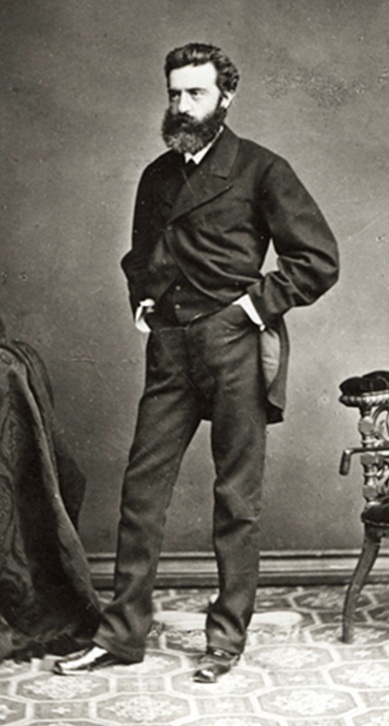
Above: Gustav Pick (detail).
Source: Karen Kiradi, Gustav Pick (1832-1921) Schöpfer des Fiakerliedes in Geschichten und Geschichtliches um zen Zentralfriedhof (blog)
Appendix:
Gustav Pick (1832-1921) was born in the Rechnitz ghetto in Hungary. He and his parents moved to Vienna in 1845, when Gustav was 12 or 13. The family seem to have been well-to-do: one of Gustav's uncles, Friedrich Schey, Baron Koromla, was a leading Vienna businessman during the 1860s. (1)
Gustav was never able to read music but he was a talented musician. He began taking piano lessons while working as a bank clerk or salesman and was soon playing piano in Viennese taverns. He quickly mastered other instruments -- harmonium, accordian and post horn.
Gustav began composing as well as playing, but his work did not become popular until he wrote Wiener Fiakerlied in 1884.
He composed the song at the request of one of his friends, Count Hans Josef Wilczek, who was president of the Vienna Volunteer Rescue Society. The Rescue Society had been created in response to the enormous loss of life in the Ring Theatre fire of 1881, in which Mary Vetsera's older brother died.
To mark the 100th anniversary of the first public cab stand in Vienna, Princess Pauline von Metternich organized a charity fundraiser for the Rescue Society. Count Wilczek asked Gustav to compose a song for the event and Vienna Fiakerlied was the result. A dress rehearsal in Pick's apartment was attended by Josef Bratfisch, who is also mentioned in the song.
Wiener Fiakerlied was first performed publicly at the Rotunda, a huge circular exhibition building that was constructed for the 1873 Vienna World's Fair. The performer was Alexander Girardi, a famous musical theatre star. He arrived in an open carriage dressed in the traditional fiaker costume of top hat and suit jacket and began singing as soon as he stepped out of the carriage.
The song was enormously popular and was translated into several languages, including Turkish. Gustav never received any royalties and none of his other compositions has survived.
Gustav died in 1921 at the age of 88. He left a considerable estate, including a large collection paintings and antiques. Hundreds of carriages formed the funeral procession to Vienna's Zentralfriedhof (Central Cemetery). In 1966 a Vienna street, Gustav-Pick-Gasse, was named after him.
Gustav Pick and Wiener Fiakerlied